Overview
A leading pet food manufacturer approached us to evaluate and modernise their existing wet pet food pouch production line.
The objective was clear: enable scalable growth by automating the multi-packing area, reducing reliance on manual labour, and improving operational efficiency.
The Challenge
The client’s production line, installed in 2018, featured automated filling and retorting processes. However, all end-of-line packing remained manual, requiring 22 operators per shift to pack single and multi-flavour products.
With demand rising, the business planned to expand production from:
- 1 shift, 5 days per week
to - 4 shifts, 7 days per week
This shift would increase labour requirements from 22 to 88 operators, presenting two major challenges:
- Significant operational cost increase
- Limited availability of skilled labour
Additionally, post-sterilisation handling involved pouches being stored in plastic crates, introducing complexity in handling and flow before packing.
The client needed a scalable, automated solution that could:
- Reduce labour dependency
- Maintain product quality
- Support increased throughput
- Optimise end-to-end flow
Our Approach
To deliver a robust and future-ready solution, we structured the project into three key phases:
1. Building the Design Foundation
We developed a comprehensive design file, forming the backbone of the entire project.
This included:
- Current and target line speeds and OEE
- Pouch specifications (dimensions and fill weights)
- Existing Click-Lok multipack formats and tertiary packaging
- Concept multipack designs
- Target output for automated multi-packing
- A detailed production cost model and savings forecast
- Clearly defined scope, performance targets and success criteria
This ensured all stakeholders—and potential suppliers—were working from a single, aligned vision of success.
2. Competitive Tender & Supplier Engagement
Using the design file, we developed a detailed Request for Quotation (RFQ) and issued it to four leading OEMs.
The scope extended beyond multi-packing machines to include:
- Crate unloading
- Crate restacking systems
- End-of-line palletisation
As these elements sat outside typical OEM capabilities, suppliers partnered with specialist third parties—ensuring full line integration.
Key discoveries during this phase:
- Pouch nesting issues within crates, impacting automation viability
→ A separate improvement programme was commissioned with the original crate system supplier - Seal failure rates in pouches, affecting product quality and efficiency
→ A targeted improvement plan was implemented to reduce defects
This stage didn’t just gather pricing – it identified critical process risks early, improving final solution reliability.
3. Layout Optimisation & Final Evaluation
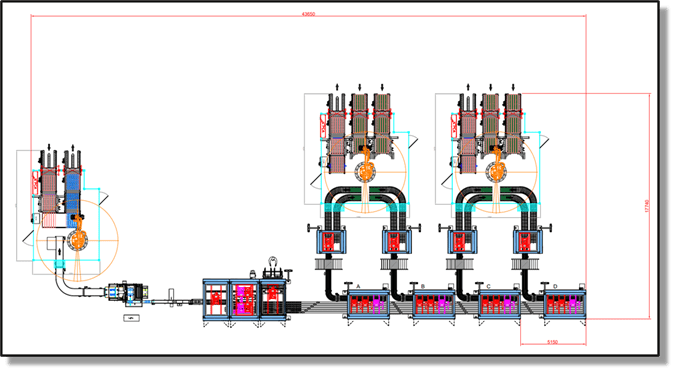
Using the client’s facility DWG layout, we redesigned the production area to:
- Minimise unnecessary product handling
- Improve flow efficiency across the line
- Define optimal material input points
- Clarify operator roles, skill levels and responsibilities
Refinement and Comparison
Following layout optimisation, suppliers submitted revised proposals. We then created a comprehensive comparison framework, including:
Investment & Performance
- Capital investment costs
- Throughput capability
- OEE performance assumptions
Supplier Strength & Capability
- Industry experience
- Machines delivered annually
- Company scale (turnover and workforce)
Operational Considerations
- Training costs and requirements
- Changeover time efficiencies
- Mean time between maintenance (MTBM)
- Spare parts cost and availability
- Remote/online support capabilities
- Skill requirements for operators and engineers
This holistic evaluation ensured the final recommendation balanced cost, capability, risk, and long-term sustainability.
The Outcome
Through a structured, data-driven approach, the client gained:
- A clear investment roadmap for automation
- A significant reduction in future labour dependency
- Improved production scalability and resilience
- Early identification and resolution of process inefficiencies and quality issues
- Confidence in selecting the right supplier and solution fit
Key Impact
By transitioning from a labour-intensive model to an automated multi-packing system, the client is now positioned to:
- Increase production without proportional labour growth
- Improve consistency and product quality
- Reduce operational risk
- Support long-term business growth
Why It Matters
This project highlights the importance of looking beyond equipment selection. By combining:
- Process understanding
- Data-led design
- Supplier benchmarking
- Operational insight
we helped the client move from a short-term capacity challenge to a long-term, scalable manufacturing solution.


Leave a Reply