The client’s brief was to assess an existing wet pet food pouch production line and develop an action plan to reduce seal failures while also decreasing the incubation time required before the pouches could be packed.
Seal integrity is the Achilles’ heel of wet pet food pouch production. Although the format offers clear advantages for consumers, such as single-serve portion control, and is cost-effective for manufacturers compared with alternative primary packaging formats like cans, achieving consistently low seal failure rates is notoriously difficult. In most operations it is challenging to match the reliability of a traditional canning line.
In some markets and for certain product types, 100% inspection is required to guarantee pouch integrity. However, this approach is expensive and requires significant time, labour, and floor space. Consequently, the majority of pet food manufacturers aim to achieve single-day release, eliminating incubation periods and subsequent inspection wherever possible.
To achieve this goal, the problem must be addressed on three key fronts:
- Process Control
The repeatability of the recipe and process is critical. The question is how tightly the production process can control variation and maintain a narrow standard deviation. Greater consistency in formulation and filling significantly reduces the risk of seal contamination or mechanical stress during sealing. - Seal Integrity Monitoring
The ability to predict seal failures before they occur is essential. Implementing predictive measurement systems can identify early warning signals and allow corrective action before significant defects arise. - Equipment Maintenance
Seal integrity is highly dependent on the condition of the filling and sealing equipment. This includes the mechanical mechanisms responsible for opening, filling, and sealing the pouch, as well as the condition of the sealing heads themselves.
Establishing the Baseline
To understand the scale of the issue, a baseline defect rate needed to be established. This required:
• 100% incubation
• Manual sorting and inspection
• A two-week monitoring period
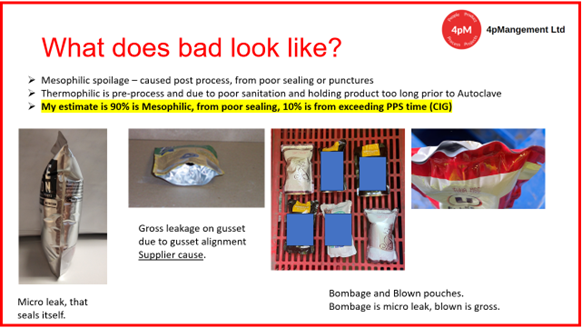
Based on the clients’ historical measurements the results looked good. But no incubation time had been allowed, the client was multipacking within 3 to 4 days of manufacture so only “gross” failures were seen. “Micro” leaks were missed and these would end up as consumer complaints.
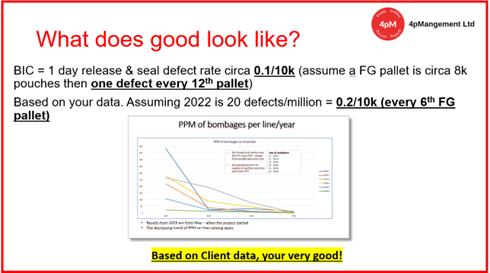
The clients historical failure rate was circa 20/million. After a two week incubation and 100% sort the data was 80/million.
We set a target that by the end of the project the failure rate should be 10/million.
Maintenance Improvements
A targeted maintenance improvement program was implemented, focusing particularly on the ultrasonic sealing heads.
On average, an ultrasonic sealing head performs reliably for approximately 10 million seals, which typically corresponds to 12–18 months of production on a standard line. Preventive replacement schedules were therefore introduced to ensure sealing performance remained within specification.
Process Consistency Improvements
Another key opportunity identified was improving the fill weight consistency of the meat chunks.
By tightening the standard deviation of chunk weight:
• The upper limit of the multi-head weigher could be reduced.
• Overall product variability could be minimized.
To achieve this, measurements of emulsion moisture were introduced to better understand:
• Seasonal variation in raw materials
• The impact of different ingredient batches
This analysis was critical to maintaining consistent chunk density.
Gel Viscosity Control
Control of gel viscosity was also proposed as an additional safeguard against seal defects.
A small increase in viscosity, around 500 cP, can help to “plug” micro-leaks, reducing the likelihood of seal failure without negatively affecting filling performance.
Predictive Seal Monitoring
To move toward a predictive maintenance approach, several advanced monitoring methods were proposed, including:
• Vacuum decay testing
• Infrared seal mapping
These technologies allow early detection of weak seals or sealing anomalies before product leaves the line.
Implementation and Results
A full action plan was presented to the client, including:
• Required capital investment
• Implementation steps
• Projected operational savings
At this stage, the client chose to proceed with:
• The maintenance improvement program
• Trials of the infrared seal inspection system
• Emulsion and gel measurements to improve Standard deviation
After 6 months all lines are consistently at 20/million with a trajectory to achieve 10/million.
Process Considerations
The above analysis was based on a two-shot filling process.
Where single-shot filling is used, additional parameters become critical, including:
• Gel viscosity
• Moisture content of emulsion
• Fat levels of emulsion
In these systems, it is also essential to implement strict maintenance regimes for:
• Gravimetric filling systems for the chunk and gel/gravy
• Dosing pistons.
These components have a direct impact on fill accuracy

 4pManagement Ltd
Leave a comment