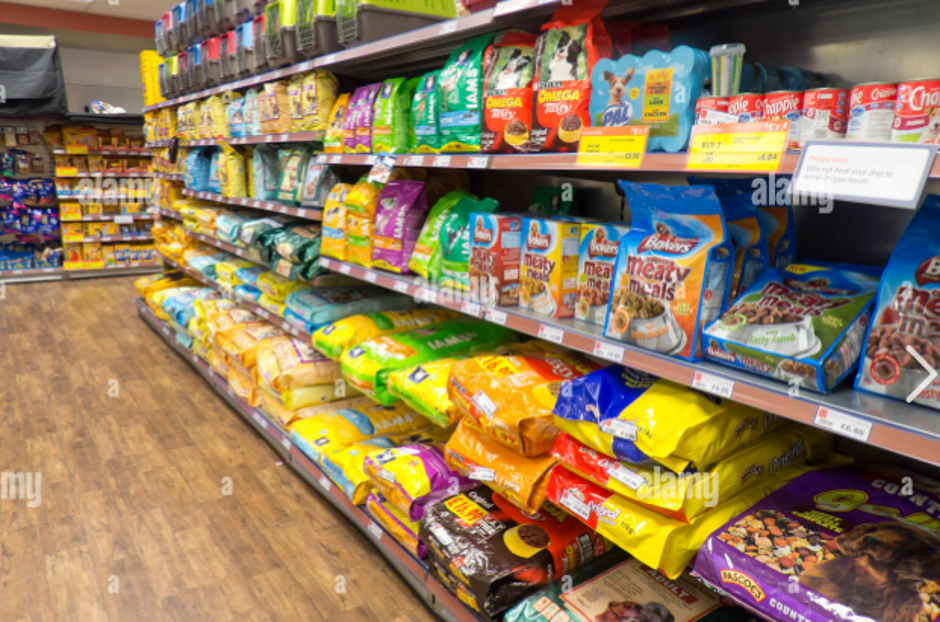
When you walk through a supermarket, have you noticed that an entire aisle, often both sides, is dedicated to pet food?
This is not simply supermarkets looking after our furry friends; it is driven by economics. Pet food is a highly profitable category.
Most consumers spend less than 30 seconds making their purchase. They search by colour, pack size, and brand, selecting the product they already know. The shelves are dominated by major players such as Nestlé Purina and Mars Petcare, alongside supermarket own-label products that closely mimic the leading brands. While the range may appear extensive, the reality is that consumers are largely limited to standard formats such as wet food, dry kibble, super-premium kibble, and treats.
There may be some variation by life stage: puppy, adult, or senior, but overall, choice remains relatively limited.
If your dog or cat has specific nutritional requirements, you often need to look beyond the supermarket. Veterinary practices, specialist pet retailers, and large out-of-town pet stores offer a wider range of products designed for particular health and dietary needs.
Most supermarket products are shelf-stable. If you are looking for raw, fresh, or frozen diets, you will typically need to shop online.
Online retailers such as Amazon, Animed, and specialist pet food suppliers offer a much broader range of products. Many provide discounts for repeat purchases, removing the need for owners to remember to reorder each month. This creates convenience for the consumer and predictable revenue for the retailer.
The Rise of the Subscription Model
A further evolution of this approach is the subscription model, adopted by companies such as Butternut Box, tails.com, KatKin, Bella & Duke, Different Dog to name a few!
These businesses invest heavily in creating a seamless customer experience. By selling directly to consumers, they can tailor products to individual pets. Customers are asked to provide information such as breed, age, weight, activity levels, preferences, and any medical conditions. This information is then used to create a personalised feeding plan.
For pet owners, the result is a convenient and highly personalised feeding solution. For the manufacturer, subscription models provide greater visibility of future demand, improved production planning, and more predictable cash flow.
UK Subscription Pet Food Companies by Revenue
| Rank | Company | Estimated Revenue (Latest Available) | Business Model |
| 1 | Butternut box | £125m–£155m | Fresh dog food subscription |
| 2 | tails.com | ~£95m | Personalised kibble subscription |
| 3 | KatKin | ~£40m–£70m (estimated) | Fresh cat food subscription |
| 4 | Bella & Duke | ~£30m–£50m (estimated) | Raw food subscription |
| 5 | Different Dog | ~£10m–£25m (estimated) | Hand-cooked dog food |
| 6 | Pure Pet Food | ~£10m–£20m (estimated) | Dehydrated dog food |
| 7 | Scrumbles | ~£5m–£15m (estimated) | Digestive-health pet food |
| 8 | Marleybones | <£10m | Air-dried subscription food |
Manufacturing Challenges
While the subscription model creates significant benefits for consumers and brands, it introduces several manufacturing challenges.
1. Customisation
Customisation can range from simply printing a pet’s name on the pack to creating a specific nutritional profile tailored to the pet’s needs.
Smart coding and order management systems allow pack customisation to be carried out as late as possible in the manufacturing process. This typically means using plain packaging earlier in production and adding customer-specific information at the final stage.
Where nutritional or calorific claims are involved, recipe design becomes critical. Manufacturers must develop a manageable range of recipes that can satisfy a wide variety of customer requirements. Many successful D2C businesses use a common base recipe and add functional ingredients where required. The effectiveness of this approach is often a key competitive advantage.
2. Specialist Ingredients
Subscription brands frequently use functional ingredients that support health, appearance, digestion, mobility, or overall wellbeing.
These ingredients are often expensive, making accurate dosing and yield control essential to profitability.
From a manufacturing perspective, they may require specialised storage conditions, precise weighing systems, and careful handling to preserve their functionality.
3. Alternative Processing Methods and Shelf Life
Traditional wet and dry pet food manufacturing relies on sterilisation or critical kill temperatures to ensure product safety. However, excessive processing can negatively impact palatability, appearance, and nutritional quality.
Alternative approaches such as raw feeding, fresh-frozen products, freeze-drying, cold pressing, and High Pressure Processing (HPP) can offer significant benefits but often introduce shelf-life challenges.
Many products rely on frozen distribution systems, requiring specialist storage, temperature-controlled logistics, and insulated packaging capable of surviving parcel delivery networks.
4. Pet Food Humanisation
One of the strongest trends in the market is pet food humanisation—the desire to create products that look and feel good enough for humans to eat.
This trend drives the use of recognisable ingredients, visible inclusions, and gentler processing methods.
Manufacturing systems must be designed to protect product appearance, texture, and functionality throughout processing and packaging. Achieving this balance often impacts line speeds and overall plant efficiency.
5. Managing Recipe Complexity
A broad product portfolio inevitably creates manufacturing complexity and can drive up finished goods inventory.
The most effective operations simplify production through the use of common base recipes and late-stage customisation, where functional, cosmetic, or premium ingredients are added only when required.
This approach reduces operational complexity while maintaining a highly personalised customer offering.
6. Scaling Production
A traditional wet pet food line can produce around 1,000 units per minute, equivalent to approximately 1.3 million meals per day and more than 400 million meals per year. Large manufacturers often operate multiple production lines across several European facilities.
By comparison, many subscription businesses operate at a scale closer to 100 million meal servings per year.
As demand increases, simply duplicating the first production line is not always the most efficient solution. While this approach adds capacity, it may also duplicate labour and capital costs without delivering meaningful economies of scale.
Successful scale-up strategies require long-term planning, ensuring each investment delivers benefits beyond capacity alone.
Secondary packing operations can also become highly complex because every shipment is customised to individual customer requirements. Automation, including collaborative robots (cobots), can significantly improve efficiency, but there is no universal solution. Careful planning and a deep understanding of the operation are essential to delivering a cost-effective result.
How 4PM Ltd Can Help
At 4PM Ltd, we act as our clients’ pet food engineers.
We combine deep industry knowledge with practical manufacturing experience, helping businesses navigate the challenges of customisation, automation, process design, scale-up, and operational efficiency.
Whether you are launching a subscription model, expanding production capacity, or preparing for the next stage of growth, we can help you identify the right solutions and avoid costly mistakes.
If you would like to discuss your subscription pet food operation and its future growth plans, please get in touch through our website.


Leave a Reply